
The Perimenopausal Woman and a Late ADHD Diagnosis: A Transformation Beyond Recognition

There is a particular kind of grief that comes from no longer recognizing yourself.
It doesn't happen overnight. It begins as a whisper, a slow burn.
You start forgetting appointments. Conversations become harder to follow. Your focus slips. Simple decisions suddenly feel overwhelming. Your emotions seem closer to the surface, a challenge to keep them at bay. You wonder why you're struggling with things that once felt effortless. You feel frozen as you try to manage through what seems to be a quintessential “normal day.”
At first, you assume you're just tired. Or stressed. Or trying to juggle too much.
Then the whisper becomes impossible to ignore.
For many women, this experience isn't simply “a natural progression in life.” It may be the intersection of perimenopause—the transitional stage before menopause—and previously undiagnosed Attention-Deficit Hyperactivity Disorder (ADHD), a neurodevelopmental condition. These two life experiences can amplify one another in ways that leave women feeling unrecognizable, scared, confused, discouraged, and deeply alone in their pain.

When the Strategies That Always Worked Stop Working
Many women with ADHD spend decades unknowingly developing systems that help them succeed.
They become highly organized, perfectionistic, people-pleasing, or exceptionally hardworking. They compensate by relying on calendars, routines, last-minute bursts of adrenaline, or simply working twice as hard as everyone else. These patterns operate automatically, without real understanding of the consequences to come.
From the outside, they often appear successful.
Inside, they've been managing an invisible balancing act that's about to fall.
Then perimenopause arrives.
As hormone levels begin to fluctuate, many of the coping strategies that once kept everything together suddenly stop working. Tasks that once required no effort, now feel impossible. Memory becomes unreliable. Concentration fades. Emotional regulation becomes increasingly difficult.
It can feel as though your brain has betrayed you. Yet, you still struggle with finding the words to define your experience.
Why Hormones Matter
Oestrogen plays an important role in learning, memory, mood regulation, and the brain's dopamine system, which is the same system involved in ADHD (Eng et al., 2024; Behrman & Crockett, 2023; Haimov-Kochman & Berger, 2014; Kulkarni, 2023). As oestrogen levels fluctuate and gradually decline during perimenopause, dopamine activity can also decrease (Wynchank, de Jong, & Kooij, 2026).
For women with ADHD, this may mean a noticeable increase in executive functioning challenges, including:
Difficulty focusing
Increased forgetfulness
Feeling mentally overwhelmed
Emotional sensitivity
Trouble initiating or completing tasks
Increased impulsivity
Some women also notice that their ADHD medication becomes less effective during certain phases of their menstrual cycle, particularly the luteal phase before menstruation, when oestrogen naturally drops (Attoe & Climie, 2023; Young et al., 2020; de Jong et al., 2023).
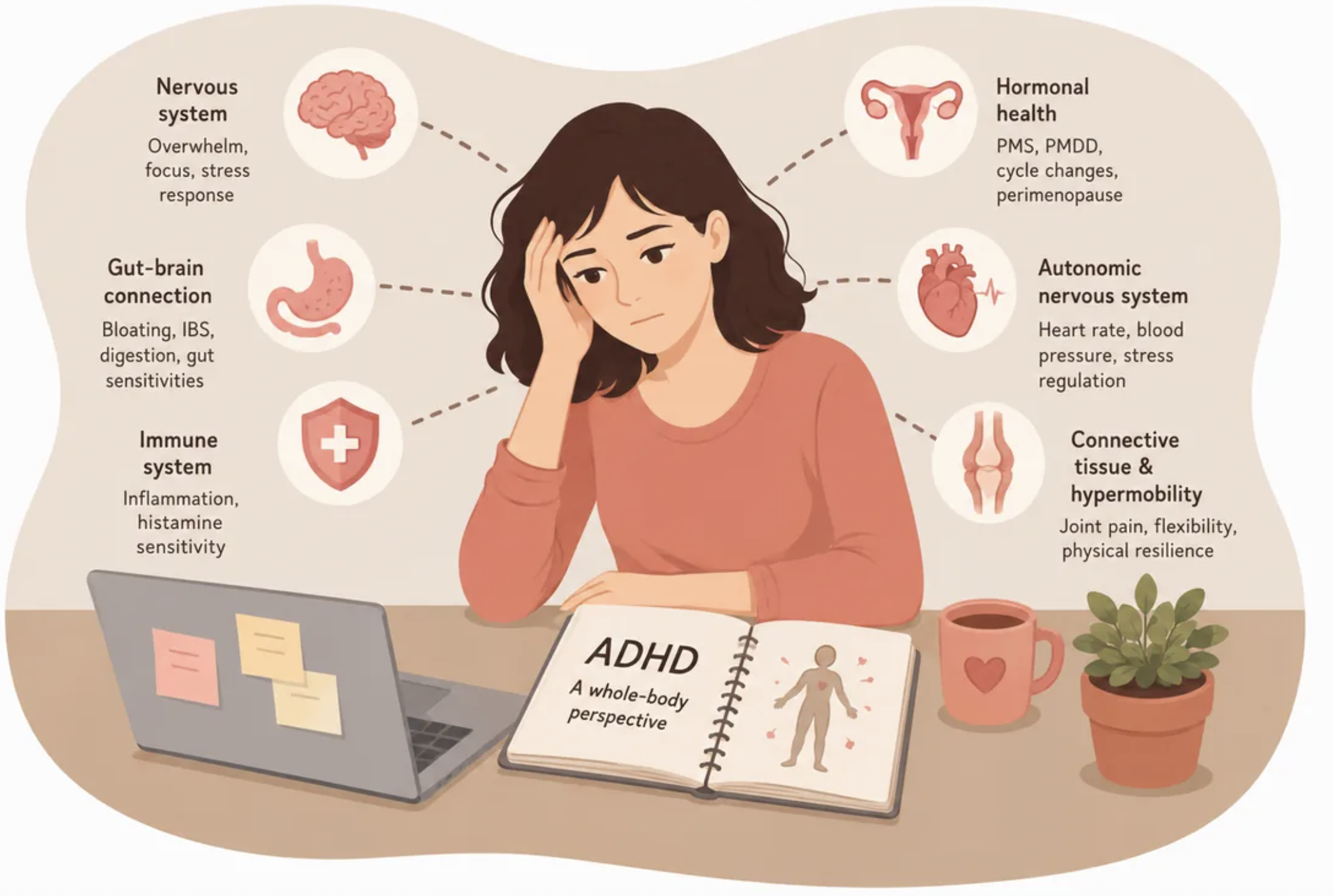
Figure 1. Infographic illustrating a whole-body perspective of ADHD. From ADHD is not just in the brain: A whole-body perspective in women, by Karine Stephan, April 24, 2026. Happy Living Nutrition.
More Than "Just Hormones"
Many women also experience symptoms associated with Premenstrual Dysphoric Disorder (PMDD) (Reilly et al., 2024; McTaggart et al., 2026), including:
Intense mood changes
Irritability
Anxiety
Fatigue
Sleep disturbances
Increased appetite
Difficulty concentrating
Feeling emotionally overwhelmed
ADHD and PMDD share many overlapping symptoms, particularly emotional dysregulation, which can make it difficult to distinguish where one ends and the other begins. For some with ADHD and PMDD, the emotional symptoms can be especially difficult to manage. Research has found higher rates of suicidal thoughts and attempts among those with both conditions, highlighting how much these symptoms can affect day-to-day life and overall well-being (Bodalski et al., 2023).
Unfortunately, women have historically been more likely to receive diagnoses such as anxiety or depression before ADHD is ever considered (Martin et al., 2024). While these conditions certainly can occur alongside ADHD, they don't always explain the full picture.
For many women, finally receiving an ADHD diagnosis later in life feels less like discovering something new and more like finally understanding themselves.
Why So Many Women Receive a Diagnosis Later in Life
Emerging research suggests that women with ADHD often begin experiencing more significant perimenopausal symptoms earlier than women without ADHD. Some studies indicate these changes may begin as early as the late 30s, with many women reporting a marked increase in ADHD symptoms between the ages of 35 and 44 (Jakobsdóttir Smári et al., 2025).
Looking back, many women recognize that the signs had always been there.
Perhaps you were the "daydreamer."
The one who always felt different.
The one who overprepared because you were terrified of forgetting something.
The one who constantly questioned whether you were simply not trying hard enough.
Receiving a diagnosis doesn't erase those years, but it can replace self-blame with understanding.
Finding Compassion Instead of Criticism
If this story feels familiar, know that you are not broken.
You are not lazy.
You are not failing.
Your brain has been working incredibly hard for a very long time.
The systems that once helped you survive may no longer be enough, and that's okay. Sometimes our minds and bodies ask us to stop pushing through and begin caring for ourselves differently.
Understanding the connection between ADHD and perimenopause can be profoundly validating. It allows us to replace shame with compassion, perfectionism with flexibility, and self-criticism with curiosity.
Most importantly, it reminds us that there is support available.
Whether that support comes through therapy, medical care, medication, lifestyle adjustments, or simply learning to understand your brain in a new way, you don't have to navigate this chapter alone.
Sometimes what feels like losing yourself is actually the beginning of finally understanding who you've been all along.
Looking for extra support?
Whether you’re adjusting to a new diagnosis or simply trying to understand the changes you’re experiencing, therapy can offer a supportive space to make sense of what’s happening, explore the impact of ADHD and hormonal changes, and collaborate on strategies that work with—not against—the way your brain and body function.
At Cup of Tea Psychotherapy, we offer evidence-based support with expertise in women’s issues, including supporting those navigating ADHD and the transitions that come with different stages of life. Together, we can work toward greater understanding, self-compassion, and a way of moving forward that feels both sustainable and aligned with your needs.
If you’re curious about how therapy can support you, we invite you to reach out.
—Blog post written by Allison Currier, Registered Psychotherapist at Cup of Tea Psychotherapy




About Allison
Allison Currier is a Registered Psychotherapist at Cup of Tea Psychotherapy. With a passion for supporting individuals with ADHD across the lifespan, she works with teens, young adults, and adults. She has a special focus on women with late ADHD diagnoses and the impact of hormonal changes on ADHD symptoms. Through her work, Allison helps clients better understand how ADHD affects daily functioning and works collaboratively with them to develop personalized strategies that strengthen executive functioning, emotional regulation, and sustainable routines. Her collaborative, strengths-based approach emphasizes self-awareness, building on individual strengths, and creating meaningful change that supports long-term well-being.
References
Attoe, D. E., & Climie, E. A. (2023). Miss. Diagnosis: A Systematic Review of ADHD in Adult Women. Journal of Attention Disorders, 27(7), 645-657.
Bartlett, L. M., Mackay, F., & Minichiello, V. (2005). The experience of self-esteem in women with attention- deficit/hyperactivity disorder. Research University of New England. https:// hdl.handle.net/1959.11/18430
Behrman, S., & Crockett, C. (2024). Severe mental illness and the perimenopause. BJPsych bulletin, 48(6), 364–370. https://doi.org/10.1192/bjb.2023.89
Bodalski E. A., Flory K., Meinzer M. C. (2023). A scoping review of factors associated with emotional dysregulation in adults with ADHD. Journal of Attention Disorders, 27(13), 1540–1558. https://doi.org/10.1177/10870547231187148
Burgess, E. R. (2000). The effect of attention deficit/hyperactivity disorder (ADHD) on psychosocial development in women [Unpublished doctoral dissertation]. The Union Institute.
de Jong, M., Wynchank, D. S. M. R., van Andel, E., Beekman, A. T. F., & Kooij, J. J. S. (2023). Female-specific pharmacotherapy in ADHD: Premenstrual adjustment of psychostimulant dosage. Frontiers in Psychiatry, 14, Article 1306194. https:// doi.org/10.3389/fpsyt.2023.130619
Eng, A. G., Nirjar, U., Elkins, A. R., Sizemore, Y. J., Monticello, K. N., Petersen, M. K., Miller, S. A., Barone, J., Eisenlohr Moul, T. A., & Martel, M. M. (2024). Attention-deficit/ hyperactivity disorder and the menstrual cycle: Theory and evidence. Hormones and Behavior, 158, Article 105466. https://doi.org/10.1016/j.yhbeh.2023.105466
Haimov-Kochman, R., & Berger, I. (2014). Cognitive functions of regularly cycling women may differ throughout the month, depending on sex hormone status; A possible expla nation to conflicting results of studies of ADHD in females. Frontiers in Human Neuroscience, 8, Article 191. https://doi.org/10.3389/fnhum.2014.00191
Hinshaw, SP, Nguyen, PT, O’Grady, SM, Rosenthal, EA. Annual research review: Attention-deficit/hyperactivity disorder in girls and women: Underrepresentation, longitudinal processes, and key directions. J Child Psychol Psychiatry. 2022;63(4):484–96.10.1111/jcpp.13480.
Holthe, M. E. G. (2013). ADHD in women: Effects on everyday functioning and the role of stigma [Master’s thesis, University of California, Berkeley]. NTNU Open.
Jakobsdóttir Smári, U., Valdimarsdottir, U. A., Wynchank, D., de Jong, M., Aspelund, T., Hauksdottir, A., … Zoega, H. (2025). Perimenopausal symptoms in women with and without ADHD: A population-based cohort study. European Psychiatry, 68(1), e133. doi:10.1192/j.eurpsy.2025.10101
Kini-Seery C, Trevaskis S, Kilbride K, Wrigley M, Bramham J. “Hormones rule me”: A qualitative exploration of the impact of perimenopause on women with ADHD. Women’s Health. 2026;22. doi:10.1177/17455057261450178
Kini-Seery C, Trevaskis S, Kilbride K, Wrigley M, Bramham J. “Hormones rule me”: A qualitative exploration of the impact of perimenopause on women with ADHD. Women’s Health. 2026;22. doi:10.1177/17455057261450178
Kulkarni, J., Gurvich, C., Mu, E., Molloy, G., Lovell, S., Mansberg, G., Horton, S., Morton, E., Uppal, T., Cashell, C., De Castella, A., Reisel, D., Dear, L., Weatherburn Reeves, N., Harris, K., Pietrobon, K., Teagle, K., Kim, B. Y., Newson, L., & Szoeke, C. (2024). Menopause depression: Under recognised and poorly treated. Australian & New Zealand Journal of Psychiatry, 58(8), 636–640. https://doi. org/10.1177/00048674241253944
Lynn, N. M. (2019). Women & ADHD functional impairments: beyond the obvious [Master’s thesis, Grand Valley State University]. Graduate Research and Creative Practice at Scholar Works.
Martin, J., Langley, K., Cooper, M., Rouquette, O.Y., John, A., Sayal, K., Ford, T. and Thapar, A. (2024), Sex differences in attention-deficit hyperactivity disorder diagnosis and clinical care: a national study of population healthcare records in Wales. J Child Psychology Psychiatry, 65: 1648-1658. https://doi.org/10.1111/jcpp.13987
McTaggart, J., Thorell, L. B., Borg Skoglund, C., Envall, N., & Kopp Kallner, H. (2026). “Controlled by Female Hormones”: A Qualitative Interview Study of Swedish Women’s Experiences of Gender-Specific Aspects of Life With ADHD. Journal of Attention Disorders, 30(6), 795-806.
Osianlis, E., Thomas, E. H. X., Jenkins, L. M., & Gurvich, C. (2025). ADHD and Sex Hormones in Females: A Systematic Review. Journal of Attention Disorders, 29(9), 706-723.
Reilly, T. J., Patel, S., Unachukwu, I. C., Knox, C.-L., Wilson, C. A., Craig, M. C., Schmalenberger, K. M., Eisenlohr-Moul, T. A., & Cullen, A. E. (2024). The prevalence of premenstrual dysphoric disorder: Systematic review and meta-analysis. Journal of Affective Disorders, 349, 534-540. https://doi.org/10.1016/j.jad.2024.01.066
Rucklidge, J. J. (1997). Attributional styles and psychopathology in women identified in adulthood with attention-deficit/ hyperactivity disorder [Unpublished doctoral dissertation, University of Calgary].
Stenner, P., O’Dell, L., & Davies, A. (2019). Adult women and ADHD: On the temporal dimensions of ADHD identities. Journal for the Theory of Social Behaviour, 49, 179–197. https://doi.org/10.1111/jtsb.12198
Young, S., Adamo, N., Ásgeirsdóttir, B. B., Branney, P., Beckett, M., Colley, W., Cubbin, S., Deeley, Q., Farrag, E., Gudjonsson, G., Hill, P., Hollingdale, J., Kilic, O., Lloyd, T., Mason, P., Paliokosta, E., Perecherla, S., Sedgwick, J., Skirrow, C., . . . Woodhouse, E. (2020). Females with ADHD: An expert consensus statement taking a lifespan approach providing guidance for the identification and treatment of attention-deficit/ hyperactivity disorder in girls and women. BMC Psychiatry, 20(1), 404. https://doi. org/10.1186/s12888-020-02707-9
Wynchank, D., de Jong, M., & Kooij, S. J. J. S. (2026). Practical tools for female-specific ADHD: The impact of hormonal fluctuations in clinical practice and from the literature. European Psychiatry, 69(1), e1. doi:10.1192/j.eurpsy.2025.10120