
Body Image and high performance sport: when the body becomes both instrument and identity
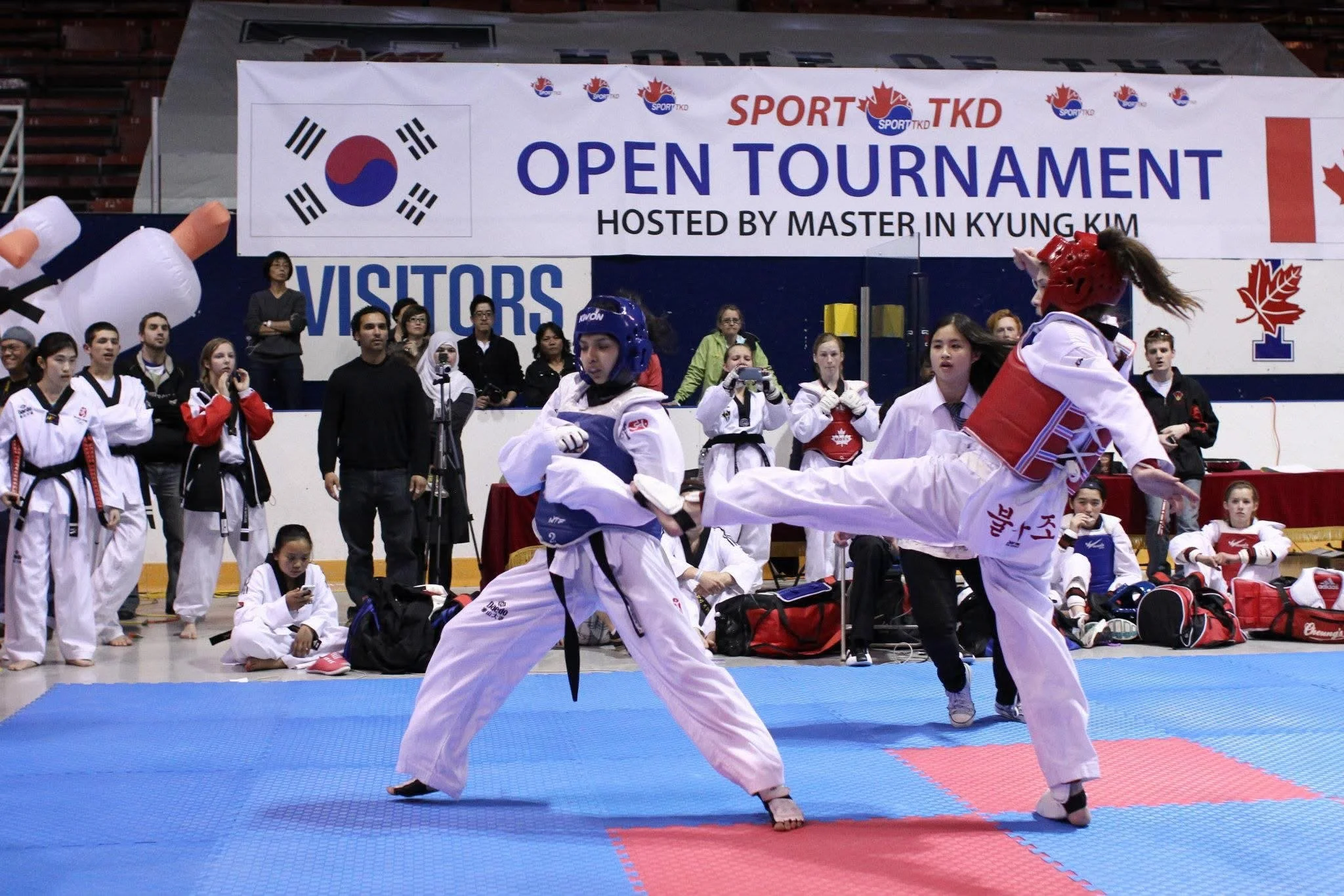
Note. Bianca Picciano (on the right) during her first-ever taekwondo sparring competition at age 12, competing in an Open Tournament in Toronto, 2010.
in high-performance sport, the body is never just a body.
It is praised when it performs and questioned when it does not. For many athletes—especially in weight-class, endurance, and aesthetic sports—the body becomes both the instrument of achievement and the site of constant evaluation (Sundgot-Borgen & Torstveit, 2004).
This can be understood through soma and sarx.
Soma is the lived, experiencing body—the body as subject. Sarx is flesh as vulnerable, exposed, and acted upon. Soma aligns with embodied subjectivity—“I am my body”—while sarx reflects the body as objectified matter, measured and controlled. Elite athletes often inhabit both at once: experiencing the body from within, while being evaluated from outside. This split can shift identity from “I am my body” to “I have a body,” shaping self-worth and belonging (Merleau-Ponty, 1945/2012) (McBride, 2021).

When the body becomes an object of control
Research shows higher rates of body dissatisfaction and disordered eating in sports where weight or appearance affects performance (Sundgot-Borgen & Torstveit, 2004; Thompson & Sherman, 1999). In such environments, extreme discipline is often rewarded, blurring dedication and harm.
A belief often develops: “if I control my body, I secure my place.” The body becomes evidence of worth, and control becomes a proxy for belonging.
My own body in the ring
My understanding of this dynamic is not only clinical but personal.
I competed in a martial art that required weight cutting. I saw how quickly the body can become an object of control, judgment, and perceived failure. Yet I also came to understand something more complex: the body was not only what I struggled against, but also what made the sport possible.
It was strong, adaptive, and resilient. It tolerated training, absorbed impact, and refined skill under pressure, but it was also a system with limits.
At one point I could not safely reduce weight further—not due to lack of discipline, but because physiology resists depletion. At the time, that felt like failure. Looking back, it was the body asserting limits, not a deficit of will.
Athletes can internalise a painful distortion: reading biological protection as inadequacy. The body’s attempt to preserve health becomes evidence of failure. (Mountjoy et al., 2018).
What cutting weight can teach us about control and threat
Weight cutting sits at the intersection of control, identity, and threat. Under restriction, the nervous system is not neutral. Hunger, fatigue, irritability, and obsessive thinking are predictable responses to low energy availability, affecting mood, cognition, injury risk, and hormones (Mountjoy et al., 2018).
In this state, the world becomes psychologically smaller.
For athletes, the stakes can feel existential: “if I do not make weight, I do not compete; if I do not compete, I risk losing identity.” This is identity fused with performance contingencies (Brewer, Van Raalte, & Linder, 1993).
What I wish had been different then
Looking back, I think about what would have actually helped.
The decision to stop weight cutting—and eventually to step away from competition—needed to come from me. At that point, the sport was deeply woven into my sense of identity and purpose. It was not simply something I did; it had become part of who I understood myself to be. When others told me I should stop before I was ready, I resisted. The more my autonomy felt threatened, the more tightly I held onto the sport.
What I did not respond well to was removal of choice. In fact, “you can’t,” often intensified the struggle.
What I needed was care that could hold complexity. Someone who could acknowledge the realities of weigh-ins, food restriction, anxiety, and uncertainty without reducing them to a simple moral lesson about health or discipline.
Someone sitting with me before weigh-ins, or helping prepare food without commentary or shame. Small acts that communicated: “I see what this costs you, and I am here with you in it.”
Judgment simplifies. Care holds tension. And that distinction matters.

Closing reflection
High-performance sport asks a great deal of the body, sometimes more than is sustainable.
Athletes meet these demands until the cost becomes difficult to recognize.
For support people, the question is not only how we optimise performance, but how we remain in relationship with both the soma and the sarx of the athlete—the lived body and the vulnerable flesh—without collapsing either into judgment.
Because beneath metrics and outcomes, there is always a body experiencing everything.
When met only with judgment, the body becomes an object. When met with care that can hold contradiction, it can return—slowly—to being a place where life is actually happening. (McBride, 2021).
where to go from here?
Whether you're looking for support with body image, performance, self-esteem, or related concerns, or simply searching for a place to start, therapy offers a collaborative space to explore what matters most to you.
At Cup of Tea Psychotherapy, we value taking the time to understand your story, your values, and your goals. If you're curious about how therapy can support you, we invite you to reach out.
—Blog post written by Bianca Picciano, Registered Psychotherapist at Cup of Tea Psychotherapy




About Bianca
Bianca Picciano is a Registered Psychotherapist and Clinical/Hospital Chaplain at The Ottawa Hospital and Queensway Carleton Hospital. With a Master of Arts in Counselling and Spirituality, a Master of Arts in Theology, and a Master of Divinity, she works with adults experiencing grief, trauma, life transitions, and more, offering evidence-based, holistic, and trauma-informed care at Cup of Tea Psychotherapy, located at 150 Isabella Street, Suite 215.

References
Brewer, B. W., Van Raalte, J. L., & Linder, D. E. (1993). Athletic identity: Hercules’ muscles or Achilles heel? International Journal of Sport Psychology, 24(2), 237–254.
McBride, H. (2021). The wisdom of your body: Finding healing, wholeness, and connection through embodiment. Bantam.
Merleau-Ponty, M. (2012). Phenomenology of Perception (D. A. Landes, Trans.). Routledge. (Original work published 1945)
Mountjoy, M., Sundgot-Borgen, J., Burke, L., Ackerman, K. E., et al. (2018). IOC consensus statement on relative energy deficiency in sport (RED-S). British Journal of Sports Medicine, 52(11), 687–697.
Sundgot-Borgen, J., & Torstveit, M. K. (2004). Prevalence of eating disorders in elite athletes is higher than in the general population. Clinical Journal of Sport Medicine, 14(1), 25–32.
Thompson, R. A., & Sherman, R. T. (1999). Athletes, athletic performance, and eating disorders: Healthier alternatives. Journal of Social Issues.